

Laser treatment can help some types of dark circles, but not all of them. It works best when the darkness comes from extra pigment (melanin) in the skin under the eyes. It is less predictable for blue or purple circles caused by visible blood vessels, and it cannot fill a hollow or remove an eye bag. So the honest answer is yes for the right cause, with realistic expectations.
This guide explains laser treatment for dark circles: which types respond, how it works, how many sessions people usually need, what results to expect, the risks around the eyes and what it costs. Influennz Clinic in Hauz Khas, South Delhi is led by Dr. Geetika Srivastava, an AIIMS-trained dermatologist (MD) with more than 10 years of experience.
Not sure which type of dark circle you have? Call or WhatsApp the clinic on 83687 78208 and ask for an under-eye assessment before you decide on any treatment.

Quick answers
- Best suited to: brown or greyish brown (pigmented) dark circles.
- Less predictable: blue or purple (vascular) circles. Not corrected by laser: hollows, bags and loose skin.
- Sessions: commonly 3 to 6, set by your dermatologist after assessment.
- Main risks to plan for: temporary or lasting darkening of the skin, and eye protection.
- Results: gradual, and sun protection is needed to keep them.
Does Laser Treatment Really Work for Dark Circles?
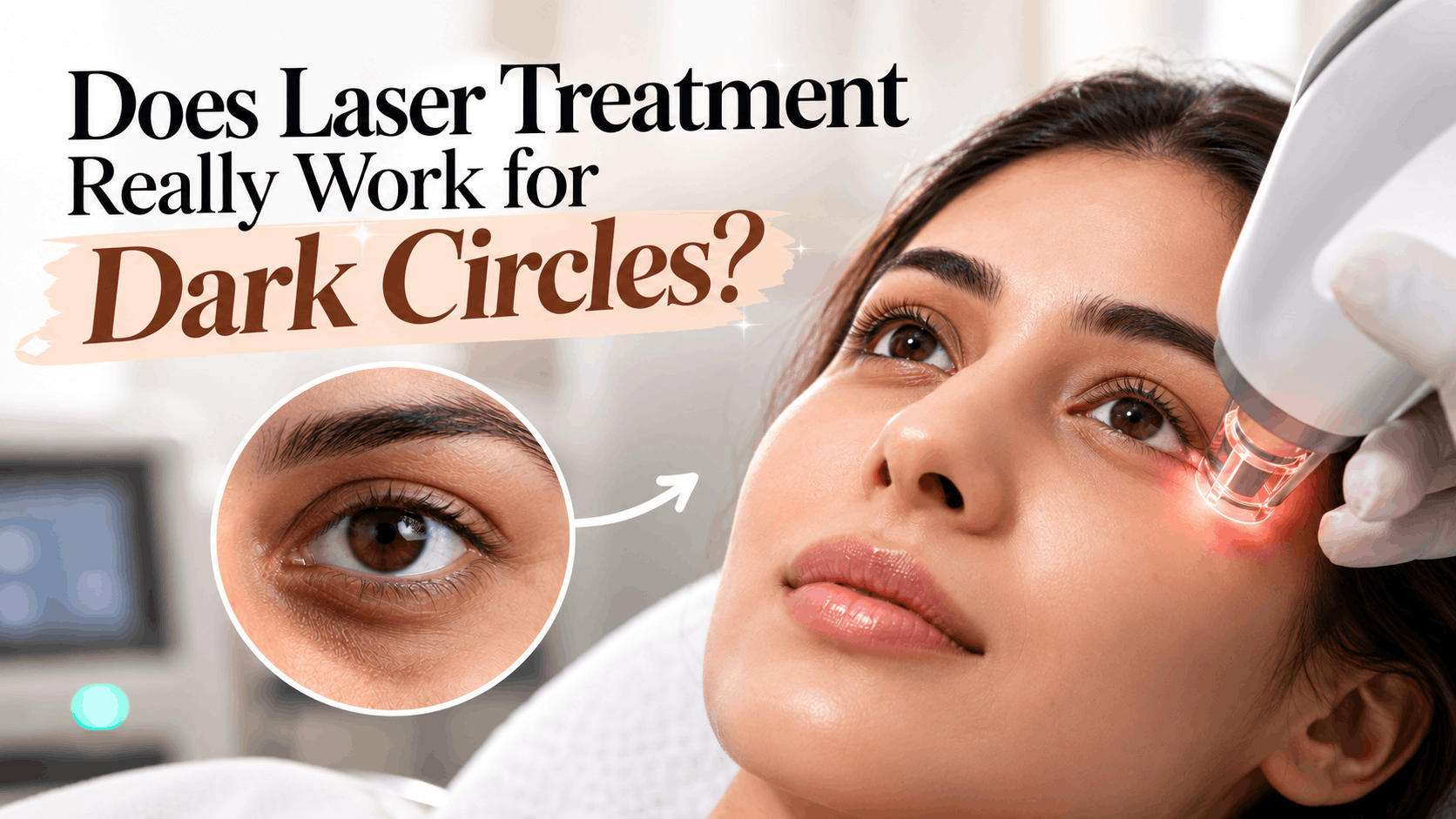
Often, yes, but it depends on why your dark circles are there. Laser light is absorbed by melanin, the pigment that gives skin its colour. When the darkness under your eyes is mainly extra melanin, a suitable laser can break that pigment into tiny fragments that the body clears gradually.
Research supports this, with limits. A 2025 systematic review and meta-analysis in Dermatologic Therapy found that lasers (including fractional CO2 and Q-switched or long-pulsed Nd:YAG) and combination treatments had the highest improvement rates of the procedures studied. In those studies, 82% of laser-treated patients and 75% of those on combination treatments were rated as having excellent or good improvement, meaning more than 50%. The authors also called for larger studies with longer follow-up, and some earlier reviews describe laser results as mild to moderate in certain pigmented and vascular cases.
What this means for you: laser is a reasonable option when a dermatologist confirms that pigment is a major part of the picture. It is not a one-size-fits-all fix, and no one can honestly promise permanent or guaranteed lightening, because dark circles are often inherited and can return with sun exposure, eye rubbing or allergies.
Which Types of Dark Circles Can Be Treated with Laser?
Dark circles are not one condition. Dermatologists group them by what you see and what is causing it, and many people have more than one type at once. That is why two people who both say they have “dark circles” can need very different treatments.
Pigmented dark circles (brown or greyish brown)
Extra melanin sits in the top layer of skin, deeper in the dermis, or both. The colour looks brown, tan or greyish brown and usually stays the same when you gently stretch the skin. This is the type most likely to respond to lasers. It is common in medium to deeper skin tones, and in Indian clinical studies the inherited (constitutional) pattern is the one doctors see most often. For related options, see our pigmentation treatment page.
Vascular dark circles (blue, purple or pinkish)
When the skin under the eyes is thin, blood vessels and the muscle beneath show through, giving a blue, purple or pink tint. The colour often looks stronger when the skin is stretched, and may look worse with tiredness. Some lasers and light devices target blood vessels, but results are less predictable than for pigment, and your dermatologist may suggest other options as well or alongside.
Structural dark circles (shadows from hollows, bags or loose skin)
Here the “darkness” is a shadow. A tear trough hollow, a fat pad bulge or loose skin creates a dip that catches shadow, and the circle often fades under direct light or when you tilt your face up. The laser does not fill a hollow or remove a bag. Reviews of the evidence point to soft tissue fillers or fat grafting as most effective for volume loss, and to eyelid surgery when excess skin is the main issue. You can read more about under-eye fillers for tear troughs.
Mixed and inherited dark circles
Most real faces have a mix, for example mild pigment plus a tear trough. If dark circles run in your family and start early, the pigment is often part of your natural skin makeup. Laser can lighten it in some people, but because the tendency remains, it may return, and improvement is a fairer goal than removal. In mixed cases, combining treatments often makes more sense than one laser alone.
How does a dermatologist decide if a laser is right for you?
The diagnosis is mainly clinical, which means it comes from looking at and examining the area. Dr. Geetika Srivastava looks at the colour, skin thickness, tear trough and cheek, along with your skin type and history: sun exposure, eye rubbing, family history, sleep, and conditions such as allergies or eczema. Conditions like atopic dermatitis and anaemia are linked with under-eye darkening in some people, so she may ask about your general health too.
A common bedside check is the eyelid stretch test. If the darkness fades when the skin is stretched, shadowing from loose skin is likely. If it looks darker or bluer, blood vessels are likely involved. If it does not change, pigment is the likely cause. Some dermatologists also use a Wood’s lamp or dermoscopy to see how deep the pigment sits. Because the right treatment depends on this step, an assessment is the sensible place to start. You can see the options we offer on our dark circle treatment page.
How Does Laser Treatment for Dark Circles Work?
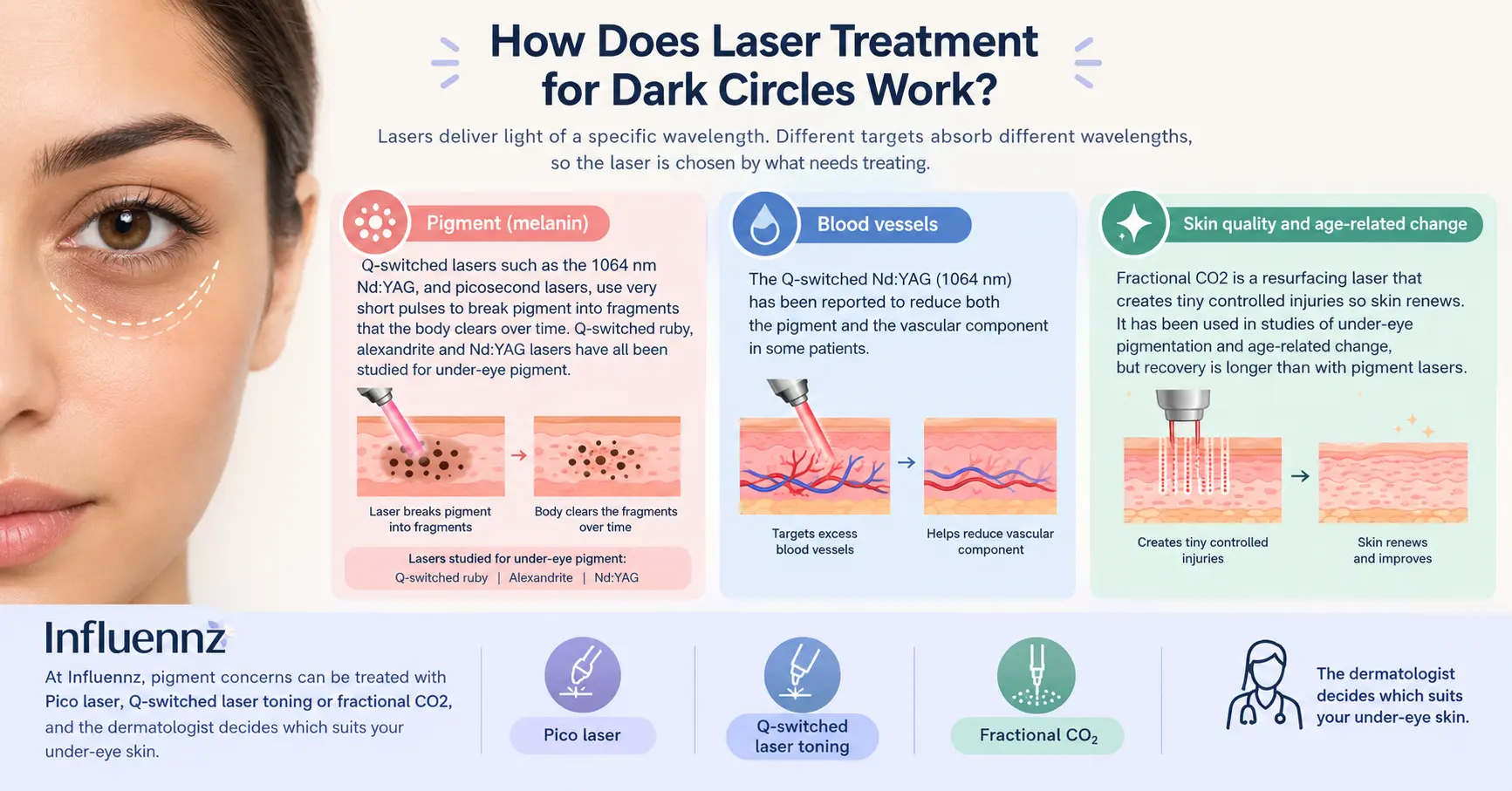
Lasers deliver light of a specific wavelength. Different targets absorb different wavelengths, so the laser is chosen by what needs treating.
- Pigment (melanin): Q-switched lasers such as the 1064 nm Nd:YAG, and picosecond lasers, use very short pulses to break pigment into fragments that the body clears over time. Q-switched ruby, alexandrite and Nd:YAG lasers have all been studied for under-eye pigment.
- Blood vessels: the Q-switched Nd:YAG (1064 nm) has been reported to reduce both the pigment and the vascular component in some patients.
- Skin quality and age-related change: fractional CO2 is a resurfacing laser that creates tiny controlled injuries so skin renews. It has been used in studies of under-eye pigmentation and age-related change, but recovery is longer than with pigment lasers.
At Influennz, pigment concerns can be treated with Pico laser, Q-switched laser toning or fractional CO2, and the dermatologist decides which suits your under-eye skin.
What happens in a session
- Assessment and photographs. The dermatologist confirms the type of dark circle, checks your skin history and recent sun exposure, and takes baseline photos.
- Preparation. The skin is cleaned and a numbing cream is applied for comfort where needed.
- Eye protection. Protective eye shields are placed before a laser is used near the eye. Stainless steel shields are the recommended type.
- Laser. The dermatologist treats the area in gentle passes. A pigment laser session usually takes about 5 to 10 minutes. You may feel warmth or mild discomfort.
- Aftercare. The area is soothed and you are given sun protection and aftercare instructions.
Who Is an Ideal Candidate for Under-Eye Laser Treatment?
Laser may be worth considering if:
- your dark circles are mainly brown or greyish brown and do not fade when you stretch the skin;
- you have used daily sun protection and dermatologist-advised topical care and want to go further;
- you understand that improvement is gradual and may need maintenance;
- your skin and eyes are healthy at the time of treatment.
Laser may not be the right first step if:
- The main issue is a hollow, bag or loose skin;
- The circles are mostly blue or purple and you expect them to clear completely;
- You have active eczema, dermatitis or infection around the eyes, or a recent tan or heavy sun exposure, because pigment change is more likely;
- You are expecting a permanent or 100% result.
Before laser is used around the eye, dermatologists also screen for conditions such as corneal disease or marked eyelid laxity. Skin tone matters as well: medium to deeper skin tones make more pigment, so laser settings need extra care.
How Many Laser Sessions Are Needed for Dark Circles?
Most treatment plans for pigmented dark circles involve about 3 to 6 sessions, but the number depends on how deep the pigment is, your skin type, the laser used and how your skin responds. Some people need fewer, and some with stubborn or inherited pigment need more, or occasional top-ups.
Published studies show how much protocols vary: courses of roughly 3 to 8 sessions, spaced anywhere from every few days to monthly, depending on the laser and settings. What changes the number for you:
- how deep the pigment sits (surface or deeper in the skin);
- your skin tone and how easily it darkens after irritation;
- the laser chosen, and whether it is combined with peels or other treatments;
- sun exposure, eye rubbing and allergies during the course.
Your dermatologist should compare photographs during the course and adjust the plan, or stop, if it is not helping.
What Results Can You Expect from Laser Treatment?
Results are gradual. Pigment usually lightens step by step across a course, not after one session, and the amount of change varies from person to person. A softer, more even tone is a realistic goal. Complete matching of the under-eye skin with the rest of your face should not be expected, especially if the circles are inherited or partly caused by hollows or thin skin.
How long do results last?
Long-term follow-up data for under-eye laser treatment is limited, and researchers have pointed out that gap. Pigment can return if you have inherited dark circles or if triggers continue: sun exposure, eye rubbing, allergies or dermatitis. Daily sunscreen, gentle eye care and treating allergies help protect results, and some people plan occasional maintenance sessions if their dermatologist advises it.
Is Laser Treatment for Dark Circles Safe?
When it is done by a trained dermatologist, with the right laser, careful settings and eye protection, under-eye laser is generally well tolerated and most side effects are mild and short-lived. The skin around the eyes is thin and sits close to the eye itself, though, so it needs more care than laser on other areas.
Possible side effects
- Redness, mild swelling, warmth, dryness or light flaking. These are the most common effects and usually settle quickly.
- Post-inflammatory hyperpigmentation. Skin can darken after irritation from the laser, particularly in medium to deeper skin tones. In the 2025 meta-analysis, this was more common after Q-switched and picosecond Nd:YAG lasers than after carboxytherapy or a picosecond 755 nm laser. It is why conservative settings and sun avoidance matter.
- Patchy lightening. This has been reported after repeated or high-energy Q-switched Nd:YAG treatment in studies of other pigment conditions, which is one reason energy is kept conservative.
Protecting your eyes
Lasers near the eye must be done with proper eye protection. An expert consensus panel of dermatologist laser surgeons and ophthalmologists states that lubricated stainless steel eye shields are mandatory for laser procedures around the eye, and that treatment should stop immediately if there is eye pain or any change in vision. In one review of eye injuries from cosmetic lasers, protection had not been used or had been removed in more than 60% of cases. Ask any clinic whether shields will be used, and tell the team straight away if anything feels wrong.
Recovery and aftercare
After a pigment laser, most people return to normal activities the same day. Mild redness, warmth or dryness can settle within hours to a couple of days. A resurfacing laser such as fractional CO2 needs longer, and your dermatologist will explain what to expect for the laser chosen for you.
- Use a broad-spectrum sunscreen daily, and wear sunglasses or a hat outdoors. Sun is the main trigger for pigment to return or worsen.
- Avoid rubbing or scratching your eyes.
- Use a gentle moisturiser, and ask before restarting retinoids, acids or lightening creams.
- Ask when makeup can go back on.
- Contact the clinic if you have eye pain, blurred vision, blistering or swelling that keeps increasing.
Laser Treatment vs Other Dark Circle Options
The best option depends on the cause. Often a combination works better than any single treatment.
| Option | Best suited to | Points to know |
| Laser | Pigmented dark circles; some vascular cases | Gradual course. Risk of pigment darkening in deeper skin tones. Needs eye protection. |
| Chemical peels | Mild, superficial pigment | Peels near the eyes must be gentle, so more sessions may be needed. Evidence suggests a moderate effect on pigmented circles. See chemical peels for under-eye pigmentation and laser vs chemical peels. |
| Fillers (tear trough) | Hollows and shadow-type circles | Do not remove pigment. See under-eye fillers. |
| PRP | Skin quality and thin under-eye skin | Studied for under-eye skin, but evidence is still developing. |
| Topicals and sunscreen | Mild pigment; maintenance after a procedure | Gentle retinoids and vitamin C are commonly advised. Lightening agents should be used under medical advice. |
| Eyelid surgery | Excess skin or fat pads | Considered when laxity or bags are the main cause, not pigment. |
What Is the Cost of Laser Treatment for Dark Circles?
The cost depends on the laser used, how much pigment there is, the number of sessions and the clinic. At Influennz, a session of under-eye laser treatment typically costs ₹4,000 to ₹12,000; another Influennz blog gives ₹3,000 to ₹8,000 for pigment lasers, and the total depends on how many sessions your plan needs. The exact quote is given after assessment, because a plan for pigment alone is not the same as one for mixed dark circles.
Whichever clinic you choose, it helps to ask which laser will be used, how many sessions are expected, whether eye shields and follow-up reviews are included, and what happens if you need extra sessions. For a wider look at pricing on a related laser, see Pico laser treatment cost. You can also see what we offer on our dark circle treatment page.
Get your dark circles assessed. Dr. Geetika Srivastava (MD Dermatology, AIIMS New Delhi; 10+ years of experience) can examine your under-eye area, tell you which type of dark circle you have and whether laser, another treatment or a combination is worth considering. Call or WhatsApp 83687 78208 or book a consultation online. Influennz Clinic, 2nd Floor, D-65, Hauz Khas Market Road, Block D, New Delhi 110016. Open Monday to Saturday, 11 AM to 8 PM; Sunday by appointment.
Frequently Asked Questions About Laser Treatment for Dark Circles
Can laser treatment completely remove dark circles?
Not reliably. Lasers can lighten pigmented dark circles, and some people see a large improvement, but complete or permanent removal cannot be promised. Inherited pigment, thin skin, hollows and sun exposure can keep dark circles visible or bring them back. A realistic goal is a lighter, more even under-eye tone.
Does laser treatment work for genetic dark circles?
It can help when the inherited darkness is mainly pigment, because the laser targets melanin. But the tendency to make extra pigment stays, so results may fade over time. Hollows and thin skin, which also run in families, do not respond to lasers. An assessment shows how much of your dark circle is pigment.
How long does laser treatment for dark circles take to show results?
Pigment usually fades gradually across a course of sessions, not after one visit. Some people notice a change after the first few sessions, others take longer. Your dermatologist will compare photographs during treatment to judge progress. Dark-circles says improvement after 2 to 4 sessions and full results in 6 to 8 weeks; decide whether to state that here.
What is the recovery time after under-eye laser treatment?
After a pigment laser, most people resume normal activities the same day. Redness, warmth or dryness usually settles within hours to a couple of days. A resurfacing laser such as fractional CO2 causes more peeling and needs longer. Your dermatologist will give the timeline for the laser chosen for you.
Is under-eye laser treatment safe for Indian skin?
It can be, with the right laser, conservative settings and strict sun protection. The main concern in medium to deeper skin tones is post-inflammatory hyperpigmentation, where skin darkens after irritation. Choose a dermatologist who assesses your skin type first, does not rush the number of sessions and uses proper eye shields.
Will dark circles come back after laser treatment?
They can. Pigment may return if the triggers continue, such as sun exposure, eye rubbing, allergies or eczema, or if the cause is inherited. Long-term follow-up studies are limited. Daily sunscreen, gentle eye care and treating allergies help, and some people plan occasional maintenance sessions if advised.
Can laser treatment be combined with fillers or peels?
Yes, and often it should be. Someone with pigment and a tear trough hollow, for example, may need a laser for the colour and filler for the hollow. A dermatologist plans the order and timing. The 2025 meta-analysis also found combination approaches among the most effective.
How can I tell if my dark circles are pigmented, vascular or structural?
In bright, even light, gently stretch the skin under your eye. If the darkness fades, it is likely a shadow from a hollow or loose skin. If it looks bluer or darker, blood vessels are likely involved. If the colour stays the same, pigment is the likely cause. This is only a rough guide, and many people have more than one type, so an examination by a dermatologist is more reliable.
Medical disclaimer. This article is for general education and does not replace an in-person assessment. Whether a laser is suitable, the laser type, settings and the number of sessions depend on your skin, eyes and medical history. Results vary and cannot be guaranteed.