What Is Sculptra? Understanding Biostimulators Injection
Sculptra is a biostimulator, not a dermal filler in the traditional sense. That distinction is the single most important thing to understand before you book a Sculptra treatment in Delhi, because it changes how the treatment feels, how long it takes to show results, and what kind of outcome you should expect.
A biostimulators injection works by convincing your own skin to rebuild its collagen, rather than by physically filling a wrinkle or a hollow with gel. Sculptra's active ingredient is poly-L-lactic acid, usually shortened to PLLA, a biocompatible, biodegradable material that has been used safely in medicine for decades, including in dissolvable surgical sutures. When PLLA microparticles are placed into the deeper layers of the skin, they trigger a controlled, gentle inflammatory response. Your body responds to this by activating fibroblasts, the cells responsible for producing new collagen, and over the following weeks and months, that new collagen physically thickens and supports the skin from within.
This is why Sculptra is officially classified as a collagen stimulator or biostimulator injection, and why it behaves so differently from hyaluronic acid dermal fillers. A regular filler adds volume the moment it is injected. Sculptra adds almost nothing on day one except a small amount of temporary water-based swelling. The real change happens gradually, as the patient's own collagen rebuilds the skin's support structure underneath.
This is explained to patients during the first consultation because it sets the right expectations. If you want to see a dramatic difference walking out of the clinic, Sculptra is the wrong treatment. If you want the patient's face to look like a rested, more youthful version of itself over the following three to four months, without anyone being able to point to "work done," Sculptra is often exactly right.
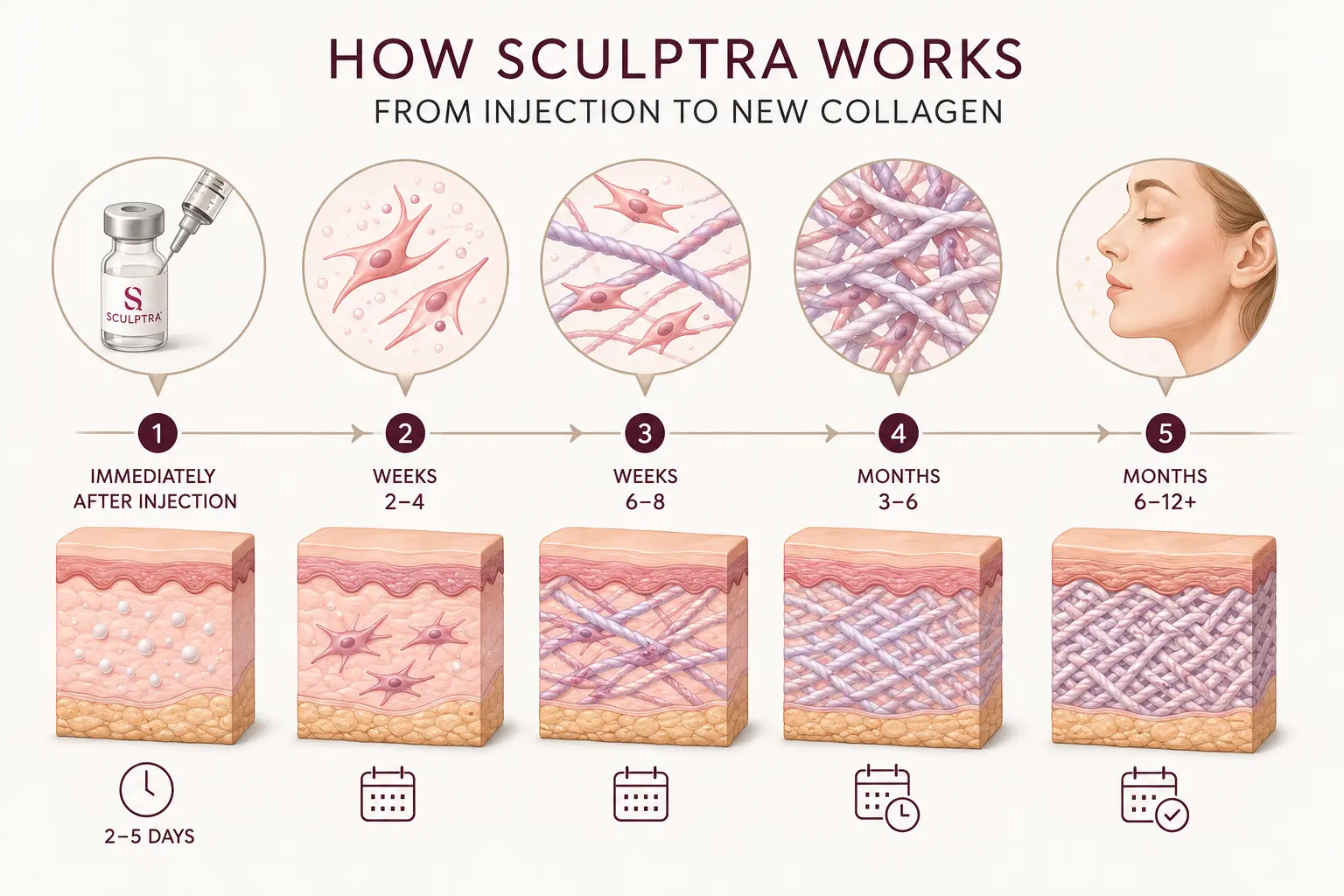
How Sculptra Works: From Injection to New Collagen
Understanding the biology helps explain why Sculptra is priced, dosed, and scheduled the way it is, so here is what actually happens after a Sculptra session.
Immediately after injection
The vial is reconstituted with sterile water before your appointment. What you see on the day, some fullness and mild swelling, is mostly the diluent, not the PLLA itself. This settles within two to five days.
Weeks two to four
Fibroblast activity increases quietly beneath the skin. Most patients notice nothing dramatic yet, though some report early improvement in skin texture.
Weeks six to eight
New collagen fibres begin to mature and integrate into the dermal matrix. This is usually when patients and their friends first start commenting on a change, often described as looking "well rested" rather than "different."
Months three to six
This is the peak collagen-building phase. Cheek hollows soften, the jawline looks more supported, and skin texture and firmness continue to improve as collagen density increases.
Months six to twelve & beyond
Collagen remodelling continues at a slower pace, and results are typically at their most complete around four to six months after the final session in a course.
Because this is a biological, cumulative process, Sculptra is never done as a single session for meaningful results. Most full treatment courses at Influennz Clinic involve two to three sessions spaced four to six weeks apart, allowing collagen production to build in layers rather than all at once.
Benefits of Sculptra: Why Patients Choose This Biostimulator
When patients ask me why they should choose Sculptra over a conventional filler for facial rejuvenation, the benefits are best understood in terms of what actually matters clinically, not just cosmetically.
It rebuilds the patient's own collagen, not just fills space.
This is the core advantage of any true collagen booster injection. Because Sculptra activates your own fibroblasts, the improvement in skin quality is structural, not just visual. Patients often notice their skin feels firmer to the touch, not only looks fuller.
Results look progressive and natural.
Because the effect builds gradually over weeks, there is no single day where the patient's face looks visibly "different." Colleagues and family typically comment that you look rested or well, not that you have had a procedure.
It lasts considerably longer than most HA fillers.
Most patients see Sculptra fillers hold their effect for 18 to 24 months, sometimes longer, compared to 9 to 18 months for many hyaluronic acid products, largely because you are looking at newly built collagen rather than a temporary gel slowly dissolving.
It treats the whole area, not just one line.
Where a filler might correct a single fold, an advanced collagen booster like Sculptra improves the structural quality of the entire treated zone, cheeks, temples, or jawline, which is why it suits patients with generalised volume loss rather than one isolated concern.
Minimal downtime.
As a non-surgical skin rejuvenation treatment, Sculptra allows most patients to return to work and normal activity the same day, with only mild, short-lived swelling.
It can improve overall skin texture, not only volume.
Beyond restoring lost fullness, many patients report smoother, more even-looking skin texture as new collagen strengthens the dermal layer, which is part of why Sculptra is increasingly described as a facial collagen booster rather than purely a volumising agent.
Sculptra vs Dermal Fillers: What Is the Real Difference?
This is one of the most common questions before a Sculptra treatment in Delhi, and it deserves a direct, honest answer rather than the vague language often seen online.
Sculptra dermal fillers comparisons come up constantly because patients assume all injectables work the same way. They do not. Traditional dermal fillers treatment in Delhi, whether hyaluronic acid-based products used for lips, cheeks, or jawline, physically occupy space beneath the skin and produce an immediate, visible result. Sculptra does the opposite: it produces almost no immediate volume and instead stimulates your body to manufacture new collagen gradually over months.
| Feature | Sculptra (Biostimulator) | Dermal Fillers (HA-based) |
|---|---|---|
| Main ingredient | Poly-L-lactic acid (PLLA) | Hyaluronic acid |
| Mechanism | Stimulates the patient's own collagen production | Physically adds volume beneath the skin |
| Speed of visible result | Gradual, over 6 to 12 weeks | Immediate, visible same day |
| Number of sessions typically needed | 2 to 3, spaced 4 to 6 weeks apart | Usually 1 session per area |
| Reversibility | Not reversible with dissolving enzyme | Can be dissolved with hyaluronidase if needed |
| Typical duration of result | 18 to 24 months, sometimes longer | 9 to 18 months depending on product and area |
| Best suited for | Widespread volume loss, overall facial thinning, skin laxity | Localised volume loss, specific contouring (lips, cheeks, chin, jawline, tear trough) |
| Downtime | Minimal, mild swelling for a few days | Minimal, occasional bruising |
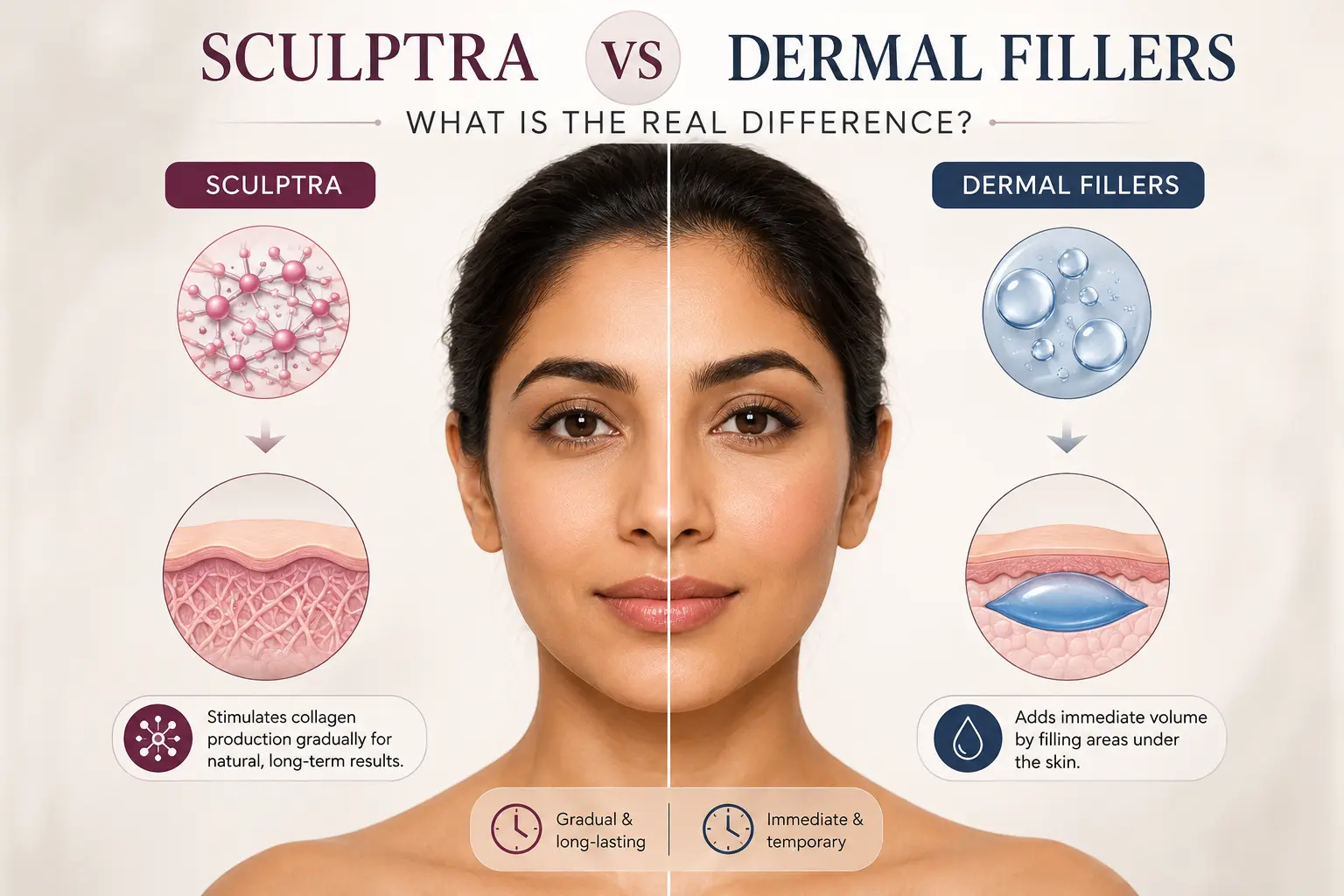
Neither treatment is inherently "better." They solve different problems. If you have one deep nasolabial fold or want fuller lips, a targeted filler is usually the more precise tool. If your whole face has lost volume and structural support, the way it commonly does after your late thirties, after significant weight loss, or after a long illness, a biostimulators injection like Sculptra addresses the underlying collagen loss rather than just filling one line at a time.
At Influennz, the clinic frequently combines the two. A patient may need Sculptra across the cheeks and temples to rebuild overall structure, plus a small amount of dermal filler in the lips or under the eyes for localised correction. You can read more about how the clinic plans combined filler approaches in our guide on choosing the right filler for the patient's face, and about dermal filler pricing in Delhi if you are comparing costs across treatment types. Choosing the right filler for your face dermal filler pricing in Delhi
Sculptra vs Profhilo vs Radiesse: Choosing the Right Biostimulator
Sculptra is not the only collagen-stimulating injectable available in Delhi, and understanding where it sits next to Profhilo and Radiesse will help you understand why the clinic recommends one over another during consultation.
| Treatment | Main Ingredient | Primary Action | Best Suited For | Typical Duration |
|---|---|---|---|---|
| Sculptra | Poly-L-lactic acid (PLLA) | Long-term collagen stimulation, gradual volume restoration | Widespread volume loss, deep structural collagen support | 18 to 24+ months |
| Profhilo | Stabilised hyaluronic acid | Bio-remodelling, hydration, mild collagen and elastin stimulation | Skin quality, hydration, early laxity, "tired skin" | 6 to 9 months per course |
| Radiesse | Calcium hydroxyapatite (CaHA) | Immediate structural support plus collagen stimulation | Jawline and lower-face contouring with faster visible effect | 12 to 18 months |
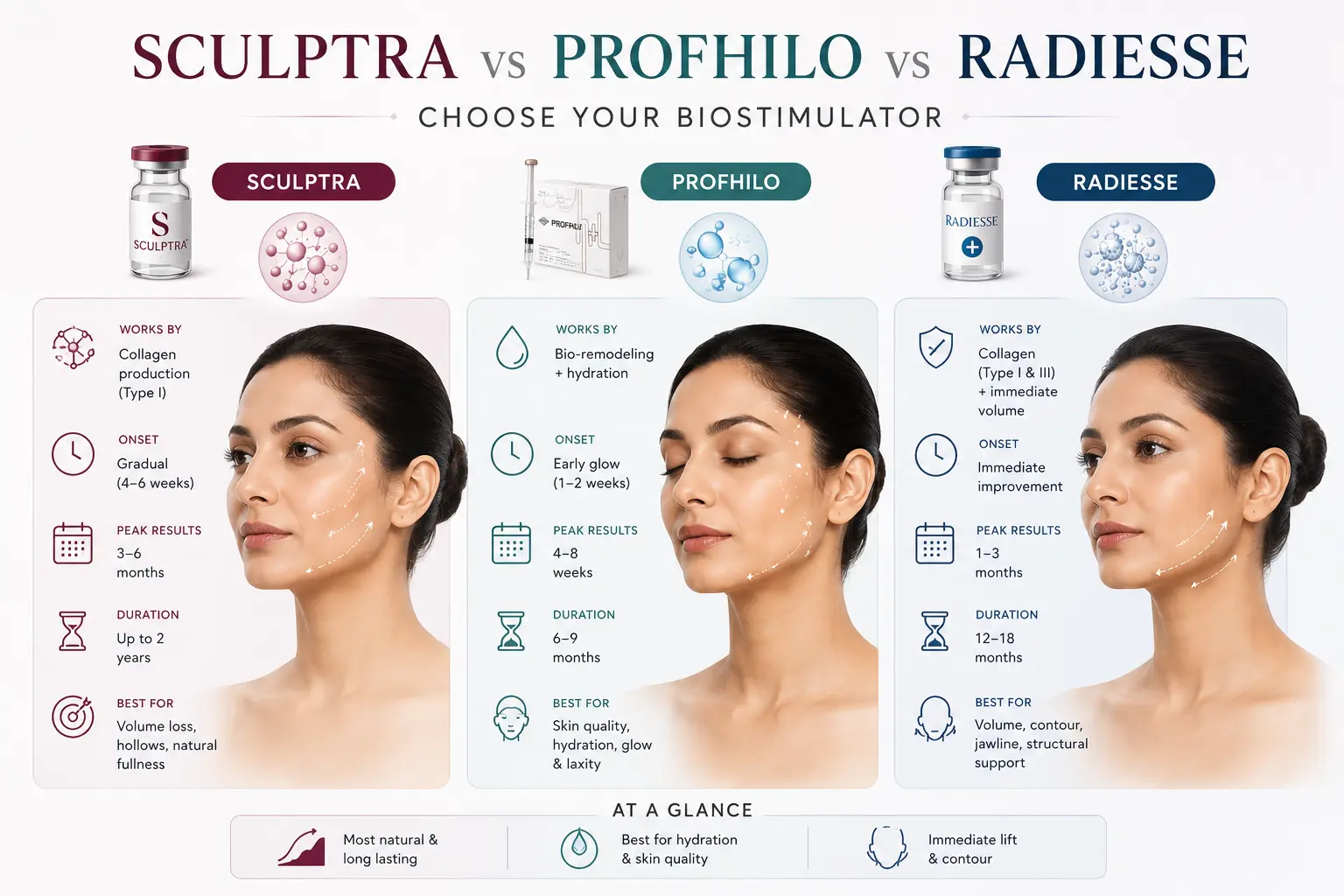
Patients often come in asking specifically about Sculptra because they have read about it, but during the facial assessment, some are better suited to Profhilo if their concern is skin quality and hydration rather than volume, or to Radiesse if they want a faster visible lift along the jawline. Part of what a proper consultation with a Sculptra specialist in Delhi should do is confirm which of these three products, or which combination, actually fits the patient's face rather than simply agreeing to whatever you ask for by name. You can read our detailed breakdown of Profhilo treatment in Delhi to compare it directly against Sculptra if skin hydration is your primary concern. Profhilo treatment in Delhi
Sculptra Treatment Cost in Delhi: Full Pricing Guide (2026)
Cost is usually an important consideration once someone understands what Sculptra does, so here is transparent, current pricing for Sculptra treatment in Delhi at Influennz Clinic. Because Sculptra is dosed by the vial and planned across sessions, the exact biostimulators price for the patient's face depends on the degree of volume loss, the areas being treated, and how many vials the treatment plan requires. This table gives you a realistic starting reference so you are not walking into a consultation blind.
| Treatment | Unit | Typical Plan | Indicative Price (INR) |
|---|---|---|---|
| Sculptra filler cost, per vial | Per vial | Cheeks, temples, or jawline; usually 2 to 3 vials per session | From ₹39,999 per vial |
| Sculptra full face cost, single session | Per session (2 to 3 vials) | Cheeks + temples, or cheeks + jawline | From ₹85,000 – ₹1,10,000 |
| Sculptra full face cost, complete course | Per course (2 to 3 sessions) | Full facial volume restoration plan | ₹1,80,000 – ₹3,20,000 |
| Sculptra dermal fillers combination plan | Per plan | Sculptra plus targeted HA filler (lips, tear trough, or chin) | Quoted after facial assessment |
| Maintenance / top-up session | Per session | Single-vial top-up at 18 to 24 months | ₹32,000 – ₹42,000 |
Note: Exact Sculptra filler cost depends on the number of vials required, the areas treated, and your individual collagen response, and is confirmed only after Dr. Geetika Srivastava has assessed the patient's face in person.
What Actually Changes the Sculptra Filler Cost
A few honest, practical factors decide what you will actually pay, and these are explained upfront so patients are not surprised at consultation:
- Number of vials required. Someone with mild, early volume loss in the cheeks may need fewer vials per session than someone correcting more significant hollowing across cheeks, temples, and jawline together.
- Number of sessions in the course. Most full results require 2 to 3 sessions. Skipping sessions to save money on the Sculptra full face cost usually means an incomplete, patchy result, because collagen builds in layers.
- Treatment areas combined. Cheeks alone cost less than cheeks, temples, and jawline together in one plan.
- Whether Sculptra is combined with dermal fillers. Many patients want Sculptra for overall structure and a small amount of HA filler for the lips or under-eyes; this changes total spend.
- Doctor-led facial assessment, not a fixed package. We do not sell "3-vial packages" blindly. Your dose is planned around your actual anatomy, which is exactly why patients are asked to come in for a consultation rather than quote pricing over WhatsApp.
Is Sculptra Worth the Cost Compared to Other Options?
This is a fair, practical question, and it deserves an honest answer. Patients frequently compare the Sculptra full face cost against two alternatives: doing nothing and continuing with skincare alone, or eventually considering a surgical facelift.
Compared to skincare alone, Sculptra offers something topical products genuinely cannot: it builds new collagen within the dermis itself, at a depth no cream or serum can reach. If your primary concern is structural volume loss rather than surface texture, no skincare routine will replicate what a properly dosed biostimulators injection achieves.
Compared to a surgical facelift, Sculptra is meaningfully less expensive, involves no surgical downtime, and carries a different, generally lower risk profile, though it also cannot replicate what surgery achieves for significant skin excess or sagging. For patients with early to moderate volume loss and reasonably good skin elasticity, Sculptra frequently delays or reduces the eventual need for more invasive intervention, which is part of how many patients think about the long-term value of the Sculptra filler cost rather than viewing it as a single isolated expense.
We are happy to discuss financing options and session-wise payment for your Sculptra treatment plan directly at consultation, since spreading a full course across sessions naturally also spreads the cost.
Who Is a Good Candidate for Sculptra?
Sculptra treatment in Delhi is most effective for a specific type of concern, and part of the consultation process is telling patients honestly when it is not the right fit, even if that means recommending something else.
You are likely a strong candidate for Sculptra if you notice:
- Generalised facial thinning, particularly in the cheeks and temples, that has developed gradually over the last several years
- Reduced skin elasticity and a slightly hollow or "deflated" look rather than isolated wrinkles
- Facial volume loss following significant or rapid weight loss, including after GLP-1 based weight loss treatment
- Early jowling caused by loss of underlying structural support rather than pure skin excess
- A preference for gradual, natural-looking change over an immediate, dramatic result
- Good general skin and health status, with no active skin infection, keloid tendency, or autoimmune condition affecting collagen metabolism
Important clinical note: Sculptra tends to be a poorer fit for patients who want an immediate lip or cheek volume change before an event next week, who have very thin skin with minimal remaining fat pad and unrealistic expectations of dramatic transformation from a single vial, or who are not able to commit to the massage aftercare protocol, which genuinely affects how smoothly the collagen builds. We will discuss all of this honestly at the consultation rather than simply agreeing to inject whatever you request.
Sculptra by Decade: Who Actually Needs It, and When
Not every patient asking about Sculptra needs it yet, and part of an honest consultation is explaining where this treatment fits relative to other options depending on your age and skin condition.
Late 20s to early 30s
Most patients in this age group do not yet need a biostimulators injection. Early fine lines or dehydration are usually better addressed with a skin booster or Profhilo. Sculptra is rarely the right starting point here unless there is early, disproportionate volume loss.
Mid-30s to mid-40s
This is when generalised collagen decline typically becomes visible enough that patients start asking about Sculptra specifically, often describing their face as looking "tired" rather than lined. This is frequently the ideal window to start Sculptra, since building collagen proactively tends to produce a more supported long-term result than waiting until volume loss is advanced.
Late 40s to 50s
Volume loss is often more pronounced here, sometimes combined with skin laxity. Sculptra remains highly effective, though we frequently combine it with a thread lift, HIFU, or targeted filler for a more complete result, since collagen stimulation alone may not fully address significant skin excess.
60s and beyond
Sculptra can still meaningfully improve skin quality and structural support at this stage, though expectations need to be realistic about what a non-surgical collagen booster injection can achieve compared to surgical options, and this is discussed openly at consultation.
Sculptra for Face Volume Loss After Weight Loss: A Growing Clinical Focus
Over the last two years, a specific and very real pattern has become one of the most common reasons patients book a Sculptra consultation at Influennz Clinic: facial volume loss following rapid or significant weight loss, including weight loss achieved through GLP-1 treatments such as Ozempic or Mounjaro.
When weight loss happens quickly, the face is often one of the first places to show it, sometimes before the rest of the body catches up. Fat pads in the cheeks and temples that previously kept the patient's face looking full can shrink noticeably, leaving a gaunt or aged appearance that feels disproportionate to how good you otherwise feel about your weight loss progress. This is sometimes informally called "Ozempic face," though the underlying mechanism, loss of facial fat volume, is the same regardless of what caused the weight loss.
Sculptra is particularly well suited to this specific concern because it addresses generalised volume loss across the cheeks, temples, and midface rather than one isolated area, and because the gradual, cumulative nature of the treatment matches how gradually this kind of facial volume loss usually developed. If this describes a patient's situation, mention your weight loss history and timeline clearly at the consultation, since it directly affects how the clinic plans your Sculptra treatment in Delhi, including how many vials and sessions the patient's face is likely to need.
Clinical Focus: Weight Loss Recovery
Customized PLLA Protocol- Multi-Zone Restoration: Rebuilds mid-face & temple structural support simultaneously.
- Natural Collagen Layering: Gradual biological restoration that harmonises with body transformation.
- Doctor-Tailored Dosing: Planned individually based on weight loss timeline and facial anatomy.
Treatment Areas for Sculptra in Delhi
Sculptra is versatile across the face, though not every area is appropriate for it. At Influennz, the treatment areas we most commonly plan for are:
Cheeks and mid-face
The most requested area, since mid-face volume loss is one of the earliest and most visible signs of collagen decline, and restoring it here has a lifting effect on the whole lower face.
Temples
Hollow temples age the face significantly and are often overlooked; Sculptra rebuilds structural support here gradually and safely.
Jawline and lower face
For patients with early jowling caused by collagen loss rather than pure skin laxity, Sculptra can help re-support the jawline contour over several months.
Nasolabial folds & tissue
Rather than filling the fold directly, Sculptra improves the surrounding skin's structural quality, softening the fold's appearance indirectly.
Safety exclusion note: Sculptra is generally not used in the lips, directly under the eyes, or very close to the eyelids, since these are thin, mobile areas where nodule risk is higher and precision volume is better achieved with hyaluronic acid filler instead.
What Happens During Your Sculptra Session at Influennz Clinic
A lot of the anxiety around any aesthetic injectable procedure comes from not knowing what the appointment itself actually involves, so here is exactly what to expect.
Facial assessment and consultation
Dr. Geetika Srivastava examines your facial anatomy, skin quality, and volume loss pattern, discusses your goals, and confirms whether Sculptra, an alternative biostimulator, or a combination approach suits you best.
Numbing
A topical anaesthetic is applied to the treatment areas 15 to 20 minutes before injection to keep the procedure comfortable.
Reconstitution
Sculptra arrives as a freeze-dried powder and is reconstituted with sterile water in advance of your appointment, following manufacturer dilution guidelines, so it is ready to inject smoothly and evenly.
Injection
Using a fine needle or cannula depending on the treatment area, Sculptra is placed into the correct tissue plane in small, controlled amounts, or boluses. This session typically takes 30 to 45 minutes.
Massage
Immediately after injection, the treated area is massaged thoroughly to distribute the product evenly and reduce the risk of lump formation.
Aftercare instructions
You are given the "5-5-5" massage protocol to follow at home, along with guidance on activity and sun protection.
Most patients return to normal activities the same day, with only mild, temporary swelling at the injection sites.
What to Avoid Before and After Your Sculptra Session
Simple preparation and aftercare steps make a genuine difference to comfort, bruising, and how evenly the patient's results build, so the clinic asks every patient to follow these before and after treatment.
Before your session:
- Avoid blood-thinning medication and supplements, including aspirin, ibuprofen, fish oil, and vitamin E, for about a week beforehand where medically safe to do so, to reduce bruising risk.
- Avoid alcohol for at least 24 hours before your appointment.
- Stay well hydrated in the days leading up to treatment.
- Tell your Sculptra treatment doctor about any prior filler treatments, history of nodule or granuloma formation, keloid tendency, or autoimmune conditions before your session.
After your session:
- Follow the 5-5-5 massage protocol exactly as instructed.
- Avoid vigorous exercise, saunas, and extreme heat exposure for 24 hours.
- Apply sunscreen daily; UV exposure affects collagen quality and skin recovery generally.
- Avoid makeup on the treated area for the first 24 hours.
- Attend your scheduled follow-up sessions; skipping sessions in your course is one of the most common reasons results feel incomplete.
The 5-5-5 Massage Rule: Why Aftercare Matters More With Sculptra
This is one part of Sculptra aftercare that many clinics mention only briefly, but it genuinely affects your result, so the clinic explains it properly rather than glosses over it.
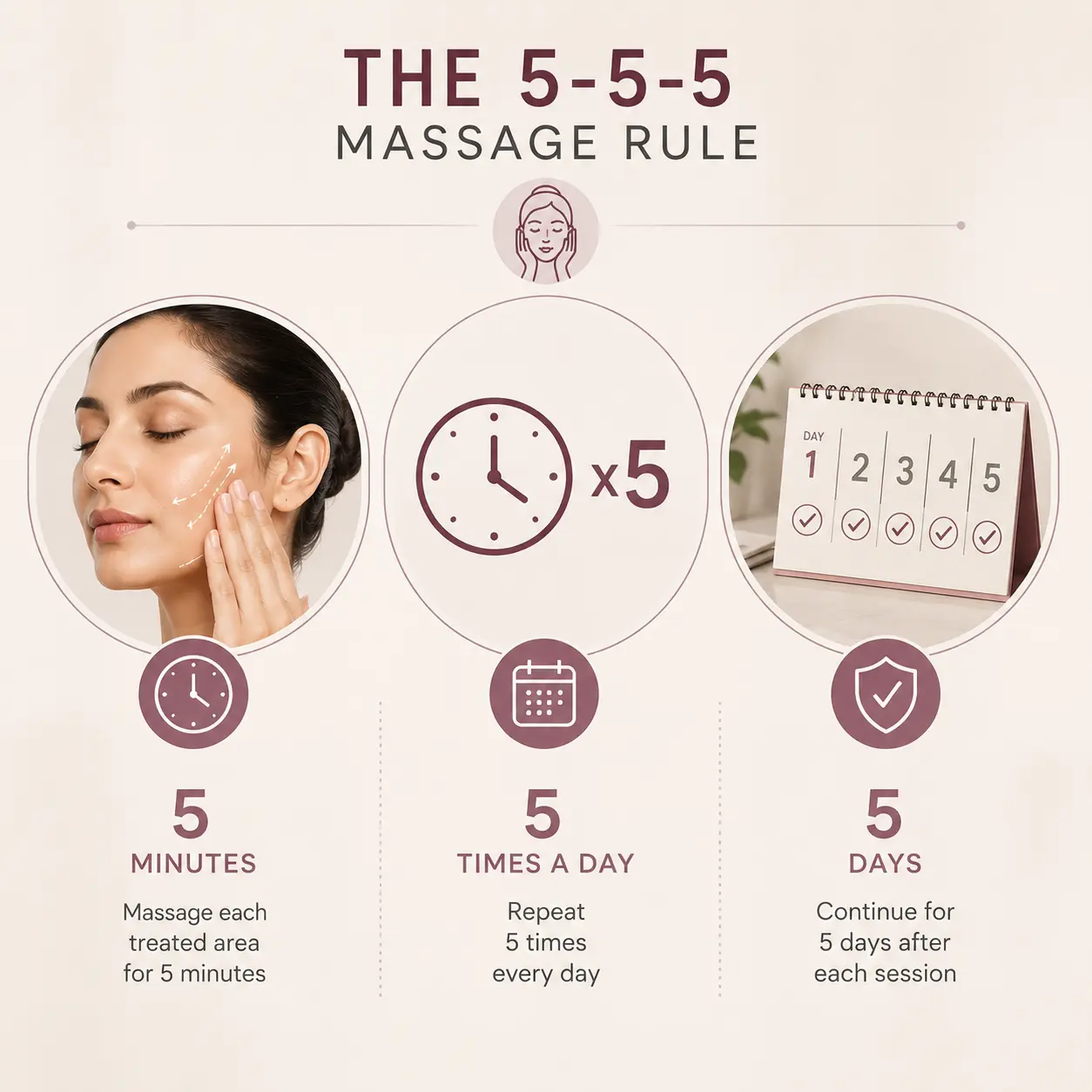
After each Sculptra session, you will be asked to massage the treated area for five minutes, five times a day, for five days. This is often called the 5-5-5 rule. The reason it matters is mechanical, not cosmetic: freshly injected PLLA particles need to be distributed evenly through the tissue while they are still settling, otherwise they can clump together and form small, palpable nodules under the skin as collagen builds around them unevenly. Patients who follow the massage protocol consistently have a meaningfully lower rate of nodule formation than those who skip it.
Clinical commitment: We walk you through the technique in person before you leave the clinic and follow up to confirm you are doing it correctly, because this single instruction is one of the most effective, low-cost ways to protect your own results.
Combining Sculptra With Other Treatments at Influennz Clinic
Facial ageing rarely has one single cause, which is why Dr. Geetika Srivastava frequently plans Sculptra as part of a broader, personalised strategy rather than as an isolated treatment, depending on what your facial assessment shows.
Sculptra with Botox
Botox addresses dynamic wrinkles caused by muscle movement, such as forehead lines or crow's feet, while Sculptra rebuilds structural volume. These target entirely different causes of facial ageing and combine well in the same overall plan.
Sculptra with Profhilo
Some patients need both structural volume and improved skin hydration and quality. In these cases, the clinic often sequences Sculptra for structural support alongside Profhilo for bio-remodelling and hydration, rather than relying on either alone.
Sculptra with dermal fillers
For patients who need overall facial collagen support plus a specific, localised correction, such as fuller lips or a sharper jawline, the clinic combines Sculptra with targeted hyaluronic acid dermal fillers as part of one cohesive treatment plan.
Sculptra with HIFU or thread lifts
In patients with both volume loss and genuine skin laxity, particularly those in their late 40s and beyond, combining a collagen booster injection like Sculptra with a mechanical lifting treatment such as HIFU or a thread lift often produces a more complete result than either treatment alone. You can read more in our guide on non-surgical treatments for sagging skin.
No combination is recommended without a proper facial assessment first. The right sequence and spacing between treatments matters clinically, and this is planned individually for every patient at Influennz Clinic.
Results Timeline: When Will You See a Difference?
Because Sculptra works through the patient's own collagen production, the timeline is genuinely different from a filler, and this expectation is important to set clearly so you are not disappointed at the two-week mark.
- Days 1 to 5: Temporary swelling from the diluent, which is not the actual treatment effect. This settles quickly.
- Weeks 3 to 4: Fibroblast activity increases. Skin may start to feel slightly firmer to the touch, though visible change is usually still subtle.
- Weeks 6 to 8: The first genuinely visible improvements in skin firmness and mid-face support typically appear here.
- Months 3 to 4: After the full course of sessions, this is usually when the cumulative collagen effect is most visible, and when the clinic takes comparison photographs against your baseline.
- Months 6 and beyond: Continued, slower collagen remodelling maintains and can subtly refine the result further.
If a patient is booking Sculptra ahead of a wedding, an important event, or a specific date, this timeline is critical. Sculptra needs to be started at least three to four months in advance, and ideally earlier, to show its full effect. It is not a treatment for two weeks before an event.
Sculptra Before and After: What Realistic Results Look Like
Patients frequently ask what an honest "before and after" looks like, since social media tends to show either dramatic transformations or nothing useful at all. In practice, a well-planned Sculptra treatment in Delhi should produce:
- Cheeks that look supported and slightly fuller rather than flat or hollow, without looking "done"
- A jawline with improved definition, particularly in patients with early collagen-related jowling
- Overall skin that appears firmer, smoother in texture, and generally more resilient
- A face that friends describe as "you just look well rested" rather than "you had something done"
What it will not do is dramatically reshape the patient's face, correct significant skin excess from ageing or weight loss on its own, or replace what a surgical procedure achieves. Setting this expectation honestly at consultation is, in my experience, the single biggest factor in patient satisfaction with biostimulator treatments.
Safety, Side Effects and Real Patient Concerns
This section addresses the questions patients actually search for online and ask privately in consultation, rather than the sanitised list usually found on clinic websites.
Is Sculptra Safe?
Yes, when performed by an experienced injector with correct product dilution, injection depth, and technique. Sculptra has been used in aesthetic medicine for over two decades internationally, and PLLA itself has a long safety record in medical devices and dissolvable sutures. Common, temporary side effects include mild swelling, redness, tenderness, and occasional bruising at injection sites, all of which typically resolve within a few days.
What About Nodules? This Is the Concern We Hear Most
Nodule formation is the most searched, most discussed real risk associated with Sculptra, and clinical literature reports it in a meaningful minority of cases, generally linked to injection technique, product dilution, injection depth, and how consistently the patient follows the massage protocol. This is precisely why product dilution guidelines have become more conservative over the years, why injection depth matters so much, and why the clinic takes the 5-5-5 massage rule seriously rather than mentioning it once and moving on. If a nodule does form, it is usually small, resolves on its own over time, and in rare persistent cases can be managed clinically.
In our own practice, the clinic has found that three factors matter most in keeping this risk low: adequate dilution of the Sculptra vial well ahead of injection, placement in the correct subdermal plane rather than too superficially, and strict patient adherence to the massage protocol in the days immediately following each session. We discuss all three with you directly before your first appointment, rather than leaving them as fine print in a consent form, because informed patients tend to follow aftercare more consistently, and consistent aftercare is genuinely one of the best predictors of a smooth, even result.
Is Sculptra Reversible?
No, and this is an important honest difference from hyaluronic acid filler. Sculptra cannot be dissolved with an enzyme the way HA filler can. This is exactly why the consultation and dosing plan matter so much: we build up gradually across sessions rather than over-correcting in one sitting, precisely because you cannot simply reverse it if too much is used.
How Many Vials Do I Actually Need?
There is no single fixed number, whatever a generic package price online might suggest. Facial volume loss varies significantly between individuals, and the honest answer only comes after a proper facial assessment. What the clinic can explain is that under-dosing across too few sessions is one of the most common reasons patients feel Sculptra "didn't work" when in fact the treatment plan itself was inadequate for their degree of volume loss.
Does Sculptra Work on a Very Thin Face?
This is a genuine, common concern, particularly among patients who have very little remaining facial fat. Sculptra can still help by strengthening the skin's own collagen framework, but expectations need to be realistic; a face with very limited underlying fat pad may see meaningful improvement in skin firmness and texture without a dramatic volumising effect, and in some of these cases the clinic recommends combining Sculptra with a targeted HA filler for a more complete result.
Can Sculptra Interfere With a Future Facelift or Other Surgery?
This is a fair question and one worth discussing directly with your surgeon if a surgical facelift is part of your longer-term plan, since biostimulator-induced fibrosis in treated tissue is a genuine consideration for surgical planning. If surgery may be part of a patient's future, mention this at your Sculptra consultation so we can plan the treatment areas accordingly.
Can Sculptra Be Used Anywhere Other Than the Face?
Internationally, PLLA biostimulators are also used off-label for body areas including the buttocks and hands for volume restoration; this is a distinct treatment plan with its own dosing and safety considerations and is not the focus of this facial rejuvenation page. If you are specifically interested in this, raise it directly at consultation.
Sculptra on Indian and Deeper Skin Tones
This question comes up often in consultation but is rarely addressed directly on Delhi clinic websites, so the clinic aims to answer it plainly. Sculptra is safe and effective across the Fitzpatrick skin type range, including the deeper skin tones (Fitzpatrick IV to VI) most common among Indian patients. The collagen-stimulation mechanism itself is not skin-colour dependent.
What does matter, and what we watch for specifically, is post-inflammatory pigmentation risk at injection sites, which is a genuine consideration for anyone with deeper skin tones undergoing any injectable procedure, not unique to Sculptra. Correct injection technique, appropriate depth, and gentle handling of the tissue during the massage protocol all reduce this risk meaningfully. If you have a personal or family history of keloid scarring or post-inflammatory hyperpigmentation, mention this specifically at the consultation so we can plan accordingly.
Why Some Doctors Are Cautious About Sculptra: A Fair Look at the Limitations
It is better to address this directly rather than leave patients to discover it later on forums. Sculptra is not the right treatment for everyone, and some dermatologists are genuinely more cautious about recommending it than they are about hyaluronic acid filler, for reasons worth understanding rather than dismissing. The most commonly cited concerns are the irreversibility of the treatment once injected, the technique-sensitivity around dilution and injection depth that makes outcomes more operator-dependent than with HA filler, the real, if uncommon, risk of delayed nodules that can appear weeks or months after treatment rather than immediately, and the fact that results are less predictable and controllable than with a filler you can see and adjust in real time.
None of this means Sculptra is unsafe when used correctly and on the right patient. It means the margin for error is smaller, which is exactly why we spend more time on facial assessment and aftercare education for Sculptra than for most other injectables at Influennz Clinic.
What Happens If You Stop Getting Sculptra?
Because Sculptra works by rebuilding the patient's own collagen rather than maintaining an artificial filler volume, stopping treatment does not cause any sudden loss of result. The new collagen your body has produced remains in the skin and breaks down gradually over time, at the same slow pace your collagen would naturally decline anyway. Most patients simply notice, over 18 to 24 months, that their face gradually returns closer to its pre-treatment baseline as natural collagen turnover continues, rather than experiencing any dramatic change. Many patients choose a single maintenance session every 12 to 18 months once their initial course is complete, rather than repeating a full course, to sustain results at a lower ongoing cost.
How to Choose the Right Sculptra Treatment Clinic in Delhi
With more clinics across Delhi now offering biostimulator treatments, it is worth knowing what actually separates a good Sculptra treatment clinic from one that simply stocks the product. Here is what patients should check before booking:
Qualified Medical Specialist
Confirm your injector is a qualified dermatologist or plastic surgeon, not a technician or nurse working without direct medical supervision. Sculptra is placed in deeper tissue planes than most injectables, and anatomical knowledge genuinely changes outcomes.
In-Person Anatomical Assessment
Ask for a real facial assessment before any price is quoted. A trustworthy Sculptra specialist in Delhi will examine the patient's face and volume loss pattern before recommending a specific number of vials, rather than selling a fixed package over the phone.
Hands-On Aftercare Guidance
Ask how the clinic handles aftercare and the massage protocol. A biostimulators clinic in South Delhi that only hands you a printed sheet without walking you through the technique in person is skipping a step that meaningfully affects your nodule risk.
Authenticity & Batch Traceability
Ask about the product's sourcing and authenticity. Genuine Sculptra vials should come with proper batch documentation; this matters more with an injectable placed this deep in the tissue.
Pricing Transparency
Be cautious of unrealistically low per-vial pricing. A Sculptra filler cost that looks significantly below the typical Delhi market range is worth questioning directly, since it may indicate diluted product, an inexperienced injector, or an unlicensed setting.
Responsible Clinical Protocol: At Influennz, every new Sculptra patient begins with an in-person consultation with Dr. Geetika Srivastava, not a sales call, precisely because Influennz believes this is what a responsible aesthetic injectable procedure requires.
Why Choose Dr. Geetika Srivastava for Sculptra in Delhi
Choosing the right Sculptra specialist in Delhi matters more with this treatment than with almost any other injectable, because Sculptra is placed in deeper tissue planes, is dosed cumulatively across sessions, and cannot be corrected the way HA filler can. Technique, dilution, and injection depth genuinely determine your outcome and your nodule risk.
Dr. Geetika Srivastava completed her MD in Dermatology at AIIMS, New Delhi, and has spent over 10 years in clinical dermatology and aesthetic medicine, with a particular focus on medically sound, evidence-based facial rejuvenation rather than trend-driven treatment. At Influennz Clinic in Hauz Khas, every Sculptra treatment plan begins with a full facial assessment, not a fixed vial package, because the patient's dose, injection depth, and technique need to match your specific anatomy and degree of volume loss.
Patients frequently ask why they should choose a dermatologist-led aesthetic clinic in South Delhi over a medi-spa or a general cosmetology centre for a biostimulators injection specifically. The honest answer is that Sculptra rewards precise anatomical knowledge and correct technique far more than most injectables, because there is a real cost to getting the dilution or depth wrong, and because you cannot simply dissolve away a mistake. A doctor-led aesthetic injectable procedure, performed by someone trained in facial anatomy at a medical level, is not a marketing phrase here; it is the actual reason technique-sensitive treatments like Sculptra tend to go well or go wrong.
Clinical Heritage: Evidence-based facial rejuvenation focused on anatomical precision, individualized reconstitution, and 100% direct doctor injection.
Sculptra Treatment in South Delhi: Local Patient Guide
Influennz Clinic is based in Hauz Khas, South Delhi, and a large share of our Sculptra patients come from premier South Delhi neighbourhoods, along with patients travelling from across Delhi NCR specifically for a doctor-led biostimulators clinic in South Delhi rather than a walk-in medi-spa.
If you are researching a Sculptra treatment clinic in South Delhi, a few practical points are worth knowing before you book: ask specifically whether your injector is a qualified dermatologist or plastic surgeon rather than a technician, ask how many Sculptra vials your specific facial assessment suggests rather than accepting a flat package price, and ask what the clinic's aftercare and massage-protocol follow-up process actually looks like, since this genuinely affects your outcome.
At Influennz, all Sculptra treatment in Delhi is planned and administered personally by Dr. Geetika Srivastava following an in-person facial assessment, ensuring consistent clinical excellence from consultation to final result.
Sculptra Clinics in South Delhi: What Sets Influennz Apart
South Delhi has several established aesthetic clinics offering biostimulator treatments, and it is fair for you to compare before deciding. What patients should look for in any Sculptra clinic, including ours, is a genuine facial assessment rather than a same-day package sale, transparent discussion of the massage aftercare protocol and its role in preventing nodules, honesty about the treatment timeline so you are not promised results that arrive faster than biology allows, and a doctor who will tell you honestly if Sculptra is not the right fit for the patient's face, even if that means recommending Profhilo, Radiesse, or a dermal filler combination instead.
Beyond the credentials and the pricing transparency already covered on this page, a few things consistently come up when patients tell us why they chose Influennz as their Sculptra treatment clinic over other options in South Delhi.
Clinical Philosophy: Precision anatomical dosing, complete transparency, and patient-first ethical guidance across every biostimulator protocol.
Individualized Anatomy
Every treatment plan is designed around your individual facial anatomy rather than a fixed vial package, which means two patients booking the same biostimulators injection may leave with genuinely different treatment plans based on what their consultation shows.
100% Doctor-Led Care
Dr. Geetika Srivastava personally performs every Sculptra session rather than delegating injectable procedures to junior staff, which matters significantly given how technique-sensitive this particular treatment is.
Honest Expectations
We are transparent about realistic timelines and will tell you honestly when a different treatment, or a combination approach, is likely to serve you better than Sculptra alone.
Longitudinal Tracking
Because the clinic tracks outcomes across sessions with photographic comparison, the treatment plan can be adjusted between sessions based on how the patient's own collagen response is actually progressing, rather than following a rigid, generic protocol regardless of results.
Related Non-Surgical Treatments at Influennz Clinic
Facial ageing rarely has a single cause, which is why we often plan Sculptra alongside other treatments rather than in isolation. If you are researching Sculptra, these related pages may help you understand your full range of options:
- Profhilo Treatment in Delhi: a hyaluronic acid bio-remodelling treatment focused on skin hydration and quality rather than volume, often chosen when the primary concern is dull or dehydrated skin.
- Dermal Fillers Cost in Delhi: pricing and guidance for targeted HA filler treatment in the lips, cheeks, chin, and jawline.
- Cheek Fillers Guide: for patients whose primary concern is localised cheek volume rather than overall facial collagen loss.
- Jawline Fillers in Delhi: for structural jawline contouring, sometimes combined with Sculptra for patients needing both definition and collagen support.
- Best Non-Surgical Treatments for Sagging Skin: a broader comparison across HIFU, thread lifts, Profhilo, and fillers for patients unsure which category of treatment fits their concern.
- Surgical vs Non-Surgical Facelift: useful reading if you are weighing biostimulator treatment against more invasive options.
Frequently Asked Questions About Sculptra
When injected at the correct depth by an experienced injector and combined with proper post-treatment massage, migration is not a typical concern with Sculptra. Reports of unwanted product movement are almost always linked to incorrect injection depth or technique rather than the product itself, which is part of why choosing an experienced Sculptra treatment doctor matters as much as it does.
We generally avoid Sculptra directly under the eyes. This is thin, delicate, highly mobile tissue where nodule risk is meaningfully higher, and a properly placed hyaluronic acid tear-trough filler is a safer, more precise option for this specific area.
In most cases, yes, though this needs to be discussed at consultation. Tell us about any prior filler, thread lift, surgical facelift, or other injectable treatment so we can plan your Sculptra session around what is already in the tissue.
This is not a typical or expected side effect of facial Sculptra injections. Mild soreness or tenderness at the injection sites is common; genuine headache or nerve-type pain is not, and should be reported to your treating doctor rather than assumed to be normal.
True allergic reactions to Sculptra are rare, since PLLA has a long safety record and does not require pre-treatment allergy testing the way some other materials do. That said, always disclose any known drug allergies, autoimmune conditions, or previous reactions to injectables at the consultation.
Sculptra is priced and dosed per vial, not per syringe. Some clinics use the terms loosely in marketing, which understandably causes confusion; at Influennz, your quote will always specify the number of vials the treatment plan requires.
It is best to avoid makeup on the treated area for the first 24 hours to reduce infection risk and allow the injection sites to settle. After that, normal makeup use is generally fine.
This is one of the main reasons patients specifically choose Sculptra over more visible volumising treatments. Because results build gradually through your own collagen, the change is typically described as looking rested or refreshed, not as looking "done."
Most patients are more anxious beforehand than they are uncomfortable during the actual session. Topical numbing cream is applied before injection, and the discomfort is generally described as mild pressure rather than sharp pain.
Yes. Downtime is minimal, and most patients return directly to work the same day, with only mild, temporary swelling that is easily concealed or resolves within a couple of days.
Not significantly, though we recommend consistent sun protection, since UV exposure affects collagen quality generally. We will guide you on any specific adjustments during your aftercare instructions.
While Sculptra's primary purpose is collagen-driven volume restoration, many patients also notice an improvement in overall skin quality and texture as new collagen forms, functioning as an additional skin rejuvenation treatment benefit alongside the structural change.
At least three to four months in advance, ideally earlier, since Sculptra's collagen-building effect takes time to develop and cannot be rushed for a short-notice event.
PLLA biostimulators are also used off-label on the body internationally, including the buttocks and hands, though this involves a different dosing plan and is a separate discussion from facial rejuvenation.
Book Your Consultation Today & Get Extra Discount!
References and Further Reading
- Narins RS, et al. A randomized study of the efficacy and safety of injectable poly-L-lactic acid versus human collagen for the correction of nasolabial fold wrinkles. Dermatol Surg.
- U.S. FDA approval information for injectable poly-L-lactic acid (Sculptra Aesthetic).
- PMC / peer-reviewed literature on PLLA-SCA dilution protocols and nodule incidence in collagen biostimulator treatment.
- American Society for Aesthetic Plastic Surgery, injectable treatment statistics.